Saturday, November 7, 2009

¡Panamá!

Puerto Lindo is on the Caribbean Sea between Portobelo and El Porvenir (on this map).

We left Mérida the morning of September 22nd. After a layover in México City we flew nonstop to Panamá City, landing into an awesome view of the city's skyline at sunset, offering a unique view of both the Atlantic and Pacific Oceans at once. We'd booked a hotel in the city in advance online, The Hotel Aramo. It is comforting to arrive with a specific destination, especially a strange city at night. (I've also been known to travel on the fly...without a room or a clue.)


We opted to take the bus into town. We caught an express bus that cost $2.50US. There was another bus we found out about later that cost $.25US. The most popular option is a $30US cab ride. The taxi drivers called out to us that we needed a cab because it wasn't safe to take the bus, but we made it to our hotel on a miraculously direct route in 45 minutes without incident. The hotel was clean, the staff extremely friendly and helpful, there was internet service, and a little restaurant where we were given a continental breakfast the following morning as part of our $37US deal.


If you are heading anywhere considered "outback" in Panamá, which in my opinion would include every province outside Panamá City...the bus schedules often require that you spend a night in town and head out early the next day to make all your connections. The bus routes are plentiful, but complicated, and often services do not run after dark.


In the morning, Pablo schlepped our bags two blocks down a busy avenue to the nearest bus stop, where we boarded a city bus to AlBrook, the main bus terminal. All buses operating in Panamá depart from there. We were northbound to the Caribbean Coast vía the road to Colón. We easily found the Colón Express and within half an hour we were on our way. We had been warned to NOT take the bus all the way into Colón, but "to get off at an intersection with a grocery store called Sabanitas." I had maps, sat by the window, and I tried to see where we were going but the driver was hauling ass and there were no signs. Now and then a sign zoomed by on the other side of the highway, but I couldn't turn around fast enough to catch it. When I saw the first evidence of human habitation; it was a big town. We asked if it was called Sabanitas, our connection stop. It was. From this crucero we had to catch a different bus headed northeast up the coast. The ride hadn't taken as long as I'd anticipated and our ride didn't match the road on the map at all. Anyhow, before the driver flew off toward the danger zone of Colón, we managed to get off the bus with all our belongings. We immediately saw another colorful bus heading to Portobelo and Pablo hailed it. I didn't have time to tell him we were actually looking for a different bus, the Costa Norteña bus, but we were headed off in the right direction. We negotiated a taxi from Portobelo, which was actually a relaxing relief from the hustle of the buses. By noon we pulled into the driveway of Panama Adventures Guest House, met by Annie's smiling face, a hot cup of coffee, and her neighbor/friend.


That afternoon we walked around the fishing village of Puerto Lindo.


We visited the tiendas, the old church, and met some of the local folks.

Then we swam out across the bay for a long snorkel.


That evening we were all contentedly exhausted and just enjoyed sitting on the front porch. We finally made it to Panamá.

Thursday, November 5, 2009

Why Panamá?

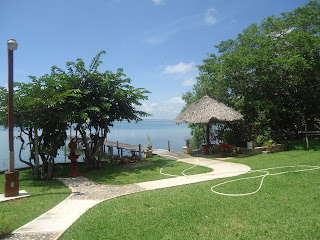
Sunrise in Puerto Lindo, Panamá


I am always on the lookout for ways to sustain my wanderlust. A few months back, I received an email from a lodge owner who found my ad on the ecotropical resort site, and we began to communicate. She owns a house with two guest rooms in Panamá, on the Caribbean Coast. Click for Panama Adventures. Annie bought her tropical getaway five years ago.

Her property is located in the Portobelo National EcoParque, where both rainforest and marine life are protected. Annie lives on the banks of a river and a short walk from the fishing village of Puerto Lindo, population 300. It is truly tropical rainforest with five species of monkeys, over 900 species of birds, including toucans, parrots, and quetzals. There is an interesting array of animal species due to Panamá´s unique location between North and South America. Its rich history is evidenced by the remains of forts and cannons, churches and cultural traditions. The coast from Portobelo to beyond Puerto Lindo is famous for its protected bays and inlets, used by boaters since pirate times. Some of the visible history dates to the early 1500's. Today the bays are dotted with pricey yachts flying flags of many countries. The area is a jumping off point for hitchhiking sailors bound for South America. Panamá's north coast is a beautiful and interesting little corner of the world, and although it has a long wet rainy season, it is not in hurricane alley.

Annie has been alternately working in the States and on her property every few months to reach her goal of opening a guest house and setting up snorkeling, kayaking and fishing excursions. She thought she was ready to open this year, on her autumn visit. We talked about me going to "resort sit", once she opened for business and then had to go back to her US job to earn more money for continued improvements. She would like to build palapas and acquire more water sports equipment. One of the tricks of operating a guest lodge in the tropics is that once you open those doors and take the first reservation, set up online services with tour operators, etc., those doors need to remain open. It's smart for Annie to line someone up to stay there, continue to check the bookings, and receive the guests who have made reservations for periods during her absence.

Pablo and I had an attack of wanderlust and had Panamá on the brain, since we didn't make it that far on our previous Central American excursion. It seemed like serendipity that Annie would contact me out of the blue. I wanted to go there on a scouting mission and meet Annie, see the area, and see if it would be feasible to plan for three month stays. She invited us to come as her guests and check it out. And so we did.

Wednesday, October 28, 2009

Chía Seeds

Several months back my sister-in-law sent me information about chía seeds. They are an Aztec food. She was trying to locate them in Houston, and wondered if we could find them here. At that time I couldn't. I have been keeping my eyes open for them all this time and recently found packages at...of all places...Chedraui (the Mexican WalMart). I don't usually post a blog like this, because the info below I copied from two different sources. But I thought it was blogworthy, and so here it is. When I googled chía seeds, there were noticeably more hits now than months ago, so maybe there is a rebirth of the chía seed.


Chia Seed - The Ancient Food of the Future (excerpts)

"In the last twenty five years, there has been a resurrection in the definition of medicine, a resurrection that amplifies the significance of our eating habits and our lifestyle. Medicine is not only defined as a treatment for illness and disease, it is now understood to be for the prevention of illness and disease. That would mean, for example, laughter is a medicine because research found it to boost the immune system. Exercise is good medicine for its cardio-vascular stimulation, muscle toning and flexibility and expelling toxins and for giving you a feeling of well-being, all immune boosters. To express a positive attitude towards life is not only good medicine for you, it is good medicine for those in contact with you. But the most important medicine, especially for the prevention of illness and disease, is our diet. It only needs our cooperation in supplying proper hydration and the needed nutrients to effectively maintain a state of well-being.

Research has revealed that more than two thirds of all deaths in the United States are diet related. More than 50% of all deaths are caused from coronary occlusion, blockage of the blood flow to the heart and/or the brain. These are all preventable deaths according to the Journal of American Medical Association which published in 1961 that, “All coronary occlusion can be eliminated by 97% through a vegetarian diet.” Fourteen hundred American’s are dying of cancer every day. In the prestigious Advances in Cancer Research, they concluded, “At present, we have overwhelming evidence… (that) none of the risk factors for cancer is… more significant than diet and nutrition.”

Because the question of what might be the optimum diet can, at times, be emotionally charged for many people, having had a significant emotional commitment in believing they know what’s best, I would like to suspend the issues of diet and introduce you to a “super” food that all would agree on. It is known as the Chia Seed. Once valued so much that it was used as currency, this unique little seed has exceptional nutritive and structural benefits.

Chia, is familiar to most of us as a seed used for the novelty of the Chia Pet™, clay animals with sprouted Chia seeds covering their bodies. Little is known, however, of the seeds tremendous nutritional value and medicinal properties. For centuries this tiny little seed was used as a staple food by the Indians of the south west and Mexico. Known as the running food, its use as a high energy endurance food has been recorded as far back as the ancient Aztecs. It was said the Aztec warriors subsisted on the Chia seed during the conquests. The Indians of the south west would eat as little as a teaspoon full when going on a 24hr. forced march. Indians running form the Colorado River to the California coast to trade turquoise for seashells would only bring the Chia seed for their nourishment.
If you try mixing a spoonful of Chia in a glass of water and leaving it for approximately 30 minutes or so, when you return the glass will appear to contain not seeds or water, but an almost solid gelatin. This gel-forming reaction is due to the soluble fiber in the Chia. Research believe this same gel-forming phenomenon takes place in the stomach when food containing these gummy fibers, known as mucilages, are eaten. The gel that is formed in the stomach creates a physical barrier between carbohydrates and the digestive enzymes that break them down, thus slowing the conversion of carbohydrates into sugar.

In addition to the obvious benefits for diabetics, this slowing in the conversion of carbohydrates into sugar offers the ability for creating endurance. Carbohydrates are the fuel for energy in our bodies. Prolonging their conversion into sugar stabilizes metabolic changes, diminishing the surges of highs and lows creating a longer duration in their fueling effects.
One of the exceptional qualities of the Chia seed is its hydrophilic properties, having the ability to absorb more than 12 times its weigh in water. Its ability to hold on to water offers the ability to prolong hydration. Fluids and electrolytes provide the environment that supports the life of all the body’s cells. Their concentration and composition are regulated to remain as constant as possible. With Chia seeds, you retain moisture, regulate, more efficiently, the bodies absorption of nutrients and body fluids. Because there is a greater efficiency in the utilization of body fluids, the electrolyte balance is maintained.

..................................................................................Chia, as an ingredient, is a dieters dream food. There are limitless ways to incorporate the Chia seed into your diet. Chia must be prepared with pure water before using recipes. The seed will absorb 9 times it’s weight in water in less than 10 minutes and is very simple to prepare.


Food Extender/Calorie Displacer: The optimum ratio of water to seed, for most recipes, is 9 part water to 1 part seed. One pound if seed will make 10 pounds of Chia gel. This is the most unique structural quality of the Chia seed. The seed’s hydrophilic (water absorbing) saturated cells hold the water, so when it is mixed with foods, it displaces calories and fat without diluting flavor. In fact, I have found that because Chia gel displaces rather than dilutes, it creates more surface area and can actually enhance the flavor rather than dilute it. Chia gel also works as a fat replacer for many recipes.


Making Chia Gel (9to1 ratio): Put water in a sealable plastic container and slowly pour seed into water while briskly mixing with a wire whisk. This process will avoid any clumping of the seed. Wait a couple of minutes, whisk again and let stand for 5 to 10 minutes. Whisk again before using or storing in refrigerator (Gel will keep up to 2 weeks). You can add this mix to jams, jellies, hot or cold cereals, yogurts, mustard, catsup, tarter sauce, BBQ sauce, etc.. Add the gel, between 50% to 75% by volume, to any of the non-bake mentioned foods, mix well and taste. You will notice a very smooth texture with the integrity of the flavour intact. In addition to adding up to 50% to 75% more volume to the foods used, you have displaced calories and fat by incorporating an ingredient that is 90% water. Use as a fat replacer, for energy and endurance, or for added great taste, buy substituting the oil in your breads with Chia gel. Top your favorite bread dough before baking with Chia gel (for toping on baked goods, breads, cookies, piecrust, etc., reduce the water ration to 8 parts water to 1 part Chia seed) for added shelf life.


There are additional benefits from the Chia seed aside from the nutritive enhancements when used as an ingredient. It was also used by the Indians and missionaries as a poultice for gunshot wounds and other serious injuries. They would pack the wounds with Chia seeds to avoid infections and promote haling. If you place a seed or two in your eyes it will clean your eyes and will also help to clear up any infections. There is a wealth of benefits beyond the information outlined in this article and treasure-trove of benefits yet to be discovered. Chia seed, having a qualitatively unique situational richness along with a profound nutritive profile is one of man’s most useful and beneficial foods and is destined to be the Ancient Food of the Future."

15 Facts About Chia Seeds http://www.healthdiaries.com/eatthis/15-facts-about-chia-seeds.html

When you think of the word "chia" you probably think of chia pets. That's what came to mind when I first heard about it (for good reason - chia pets are grown with chia seeds). I didn't pay much attention to it and walked by the bags of it for sale in Whole Foods without a second thought. It turns out I was walking past a newly rediscovered "superfood."

I say "rediscovered" because chia was prized as a superfood for thousands of years before it was nearly forgotten.

Here are 15 facts I found out about chia:

The chia plant (Salvia hispanica), sometimes referred to as chia sage, originated in the central valley of Mexico and is a member of the mint family.

Records indicate chia seeds were used as a food source as far back as 3500 B.C.

It was the third most important crop for the Aztecs, who recognized it as a "superfood" and prized it so highly that it was often used as currency.

Aztec warriors and runners are believed to have sustained themselves for an entire day on just a tablespoon of chia.

After the Spanish conquest, chia seed nearly disappeared as the Spaniards banned foods that were linked in any way to Aztec religion or tradition and virtually wiped out the complex agricultural system established by the Aztecs in order to grow foods that were popular in Spain instead.

The word chia is derived from the Aztec word chian, which means "oily."

The name of the Mexican state of Chiapas, originally called Chiapan, translates loosely to "river where the chia sage grows."

According to Aztec mythology, chia seed came from the nose of the maize god, Cinteotl.

The Chumash Indians of California also cultivated chia and prized it for its beneficial properties.
This variety of chia is often referred to as chia sage or California chia.

Chia seeds have more Omega-3 fatty acids than any other plant food, including flax seeds.

Chia seeds are about 20% protein.

When soaked in water for 30 minutes, chia seeds form a thick gel. This gel also forms in the stomach when chia seeds are consumed. That sounds bad, but researchers believe it actually slows down the rate at which digestive enzymes turn carbs into sugar, making it especially beneficial for diabetics and others with blood sugar issues.

The popular Mexican drink chia fresca is made by soaking chia seeds in water until they become gelatinous and then adding sugar and lemon or lime juice.

Chia is hydrophilic and can absorb more than 12 times its weight in water. This makes it helpful in maintaining body hydration, something that is especially beneficial for athletes who need to remain hydrated during races and endurance activities.

Chia seeds are so high in antioxidants that they do not spoil easily and can be stored for long periods, unlike flax seeds.